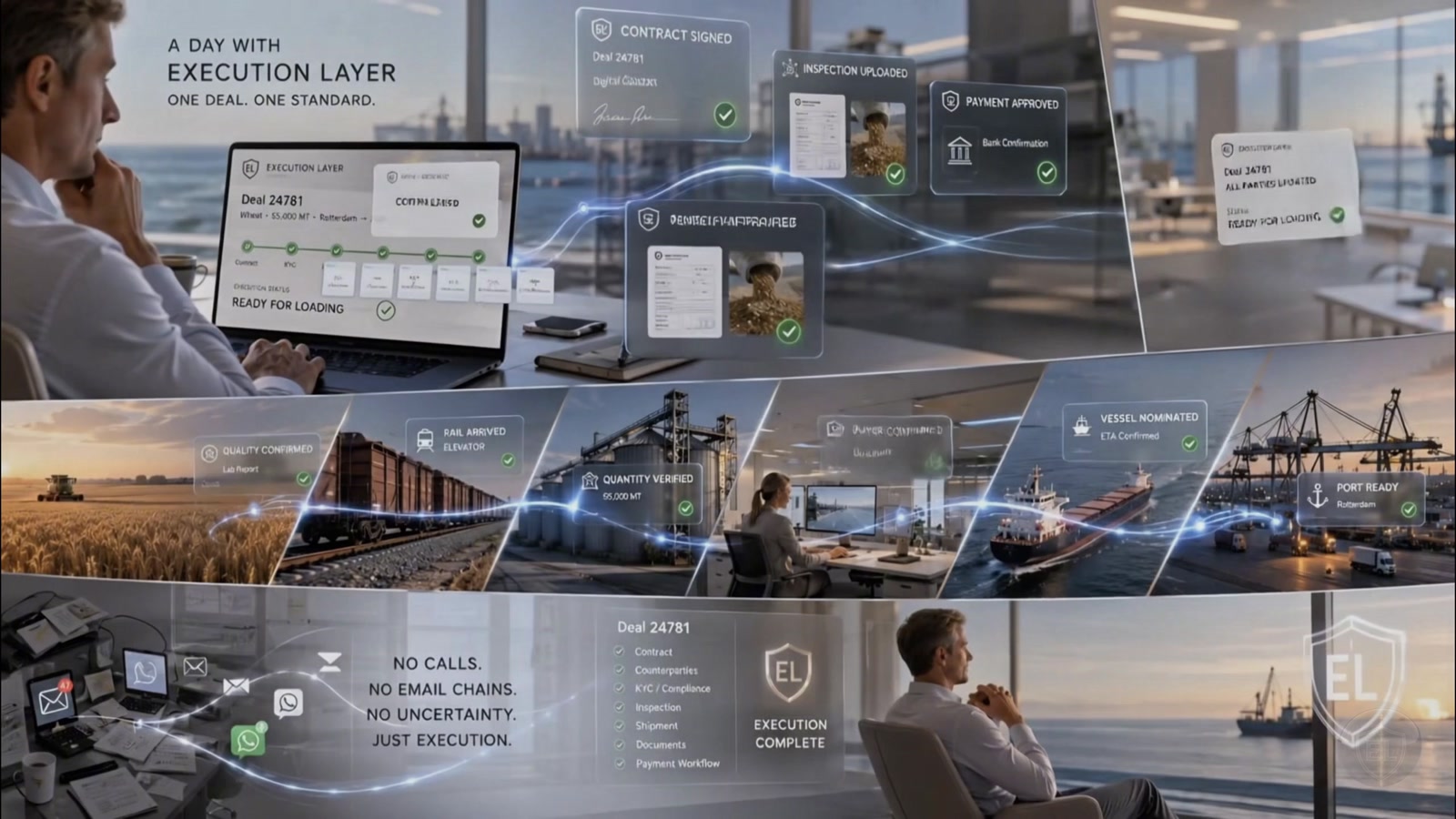
Contract-driven execution and control
Each step becomes available only when its contract-defined conditions and dependencies are satisfied.
Execution Layer begins when the contract is signed. The platform structures contract execution, automates the coordination of actions and maintains one current deal state for all authorized participants.

EL guides deal execution by bringing actions, dependencies, documents and approvals together in one shared environment — reducing manual work, delays and operational risk.
One current deal state becomes the shared working basis for every authorized participant. Within their permissions, each understands what is complete, what is in progress, what is waiting and what needs to happen next.
Illustrative execution path. Actual timelines are contract-specific and human-approved.
EL links confirmed events to obligations and maintains one current deal state — without repeated reconciliation across emails, spreadsheets and separate systems.
All seven chapters are visible from the start. Open one, several or the complete site.
After signature, execution is distributed across participants, documents and systems. This creates manual reconciliation, errors, delays, additional costs and different versions of the deal state.
Each step becomes available only when its contract-defined conditions and dependencies are satisfied.
Every action has an owner, status, prerequisite and required evidence.
One current state becomes the shared working reality for every authorized participant — within their permissions.
Deviations surface in execution context before they lead to delays.
Documents, approvals and material events form one chronological execution history.
New participants and systems connect without creating additional versions of the deal state.
EL brings obligations, actions, documents and confirmations together in one operating layer — coordinating execution, enabling controlled document exchange and maintaining one current deal state. This reduces manual work, accelerates execution and improves operational efficiency — without adding another isolated system.
Bring every participant, obligation and proof of execution into one shared state.